




The Simurgh in Persian Mythology: Meaning, Origins, and the Shahnameh
8/17/2026
The Simurgh in Persian Mythology: Meaning, Origins, and the Shahnameh
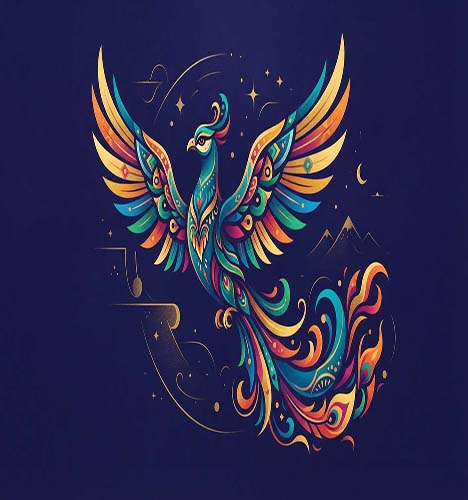
"The Simurgh (also frequently spelled Simorgh or simurg) is a legendary Iranian bird whose history dates back at least 2,500 years—or even earlier—to Aryan mythology and sacred Sanskrit texts. During the Sasanian era (a major Persian imperial dynasty that ruled from 224 to 651 AD), the motif of the Simurgh was famously inscribed on numerous goblets and vessels. It is also prominently featured in Ferdowsi’s Shahnameh (the Book of Kings, a monumental epic written in the 10th century that chronicles the history and mythology of ancient Persia), where it serves as a symbol of wisdom and intellect. Throughout history, a significant portion of Iranian illustrative art has focused on subjects that lack a physical or objective reality, yet occupy a vital place in Iranian culture and mythology. These figures embody the forces of good and evil, manifesting over thousands of years across myths, legends, and tales in the guise of demons, fairies, and imaginary animals such as dragons, the Simurgh, and other mythical creatures." A bird with an eagle-like beak, outstretched wings, and a very long, flowing tail called the Simurgh, as seen in the illustrations of various manuscripts of the Shahnameh and other works of Iranian painting.
"The Sasanian period is typically referred to as the "golden age" of pre-Islamic Iran. Among various archaeological excavations, Sasanian coins and seals have been unearthed, occasionally depicting extraordinary creatures composed of a hybrid of different animals. Beginning with the ambiguity of these creatures, some scholars have proposed identifying them in light of ancient Iranian mythology and literature. A composite winged creature with an eagle's head, a lion's paws, and a peacock's tail—typically considered Sasanian—has been referred to as the 'Persian Phoenix.' As observed on 7th-century pre-Islamic coins of Central Asia, this composite winged creature was quite explicitly linked to the concept of the Iranian Khwarrah (Divine Glory), which entered Iran at the end of the Sasanian era from a region between modern-day Afghanistan and Tajikistan. Shortly thereafter, this creature also appeared in Western arts, spreading from the Byzantine Empire and the Islamic Caliphate to all of Europe by the early 13th century. Its exact meaning among Muslims remains a subject of debate, though Christians certainly regarded it as a very fitting decoration for both religious and secular purposes. The attributes ascribed to the Simurgh in the Avesta (the primary collection of religious texts of Zoroastrianism, an ancient monotheistic faith founded by Zoroaster) and in Zoroastrian religious books (texts dedicated to preserving the theology, rituals, and cosmology of this ancient Iranian religion) as well as the Shahnameh, are entirely human-like, such as problem-solving, medicine, or speech."
The Simurgh in the Shahnameh: The Story, Role, and Symbol of Iran's Mythical Bird
The Simurgh is one of the most marvelous and mythical creatures in Iranian literature, with its presence traced across both ancient texts and Ferdowsi's Shahnameh. It is a legendary bird that plays a vital role in rescuing heroes, healing wounds, and guiding human beings. The story of the Simurgh in the Shahnameh not only belongs to the heroic section of the epic but also bridges Iranian myth and culture, embodying wisdom, healing, and generational support through the form of a wise, mythological entity. In ancient Iranian texts, the Simurgh is portrayed as a magical and wise creature, best known in the Shahnameh for its roles as an intermediary, healer, and guide. This legendary bird dwells atop Mount Alborz, where it rescues Zal (the infant son of Sam) from the mountain and raises him. It later gifts Zal its feathers, instructing him to burn them for assistance in times of trouble. On a symbolic and narrative level, the Simurgh's tale in the Shahnameh serves a dual function: it is simultaneously a teacher and a guide, a healer and a conscious spirit that appears at critical moments to come to the aid of humanity.
Why is the Simurgh so important in the Shahnameh?
If we were to remove the Simurgh from the Shahnameh, the destinies of the epic's major heroes would completely change, and this is precisely why the Simurgh holds such significance in the work. Without the Simurgh, Zal (the white-haired hero abandoned in infancy on Mount Alborz due to his unusual appearance) would never have survived, Rostam (Zal's legendary son and the greatest champion of Persian mythology) would not have been born, and even the life of Esfandiar (an invincible Iranian prince whose tragic destiny is tied to a fateful duel with Rostam) would have taken a very different path. However, the Simurgh’s importance goes beyond merely saving the heroes of the Shahnameh. It appears precisely at moments when hope is fading and wisdom and insight are needed more than ever. For this reason, the Simurgh's role can be considered one of the driving pillars of the narrative.
Why does the Simurgh help only certain characters?
One of the questions that arises when reading the Shahnameh is why the Simurgh does not help everyone. To answer this, one must examine the role of the Simurgh in the epic. The Simurgh is not tasked with solving every problem in the world! It only enters the story when the destiny of Iran or the life of someone from Zal's family is in danger. For this reason, the Simurgh's assistance in the Shahnameh is an exception, not a regular occurrence.
The Evolutionary Journey of the Simurgh: From Ancient Avestan Saena to Sufi Allegory
While the previous sections explore the Simurgh’s foundational roots in mythology and its dramatic interventions in the Shahnameh, a complete scholarly understanding of this legendary entity requires examining its linguistic evolution and its profound transition into classical Persian mysticism (Sufism).
1. From the Avestan Saena to Modern Persian Linguistically, the name "Simurgh" is a direct descendant of Middle Persian Sēnmurw, which itself derives from the Avestan mərəγō Saēnō (the bird Saena). In the oldest Zoroastrian scripture, the Avesta, Saena originally denoted a mighty bird perched atop a mythical tree of all seeds, standing beside the waters of Vourukasha. Over centuries of linguistic transformation through Middle Persian into New Persian, the components fused and shifted, eventually yielding Simurgh. This linguistic bridge proves that the creature's conceptual identity predates Islamic Persia by over a millennium, originating as an avian genius of vegetation, rain, and fertility before solidifying into an emblem of royal majesty and divine intellect.
2. The Simurgh in Sufi Mysticism: Attar’s Conference of the Birds Beyond epic literature and material culture, the Simurgh underwent its most profound philosophical transformation in Persian Sufi literature—most notably in Farid al-Din Attar’s (a renowned 12th-century Persian poet, mystic, and theoretician of Sufism from Nishapur) 12th-century masterpiece, Mantiq al-Tayyir (The Conference of the Birds, a legendary mystical epic that portrays the soul's journey toward the divine through the symbolic quest of birds). In Attar’s allegorical masterpiece, a vast flock of birds embarks on an arduous quest across seven perilous valleys to find the legendary Simurgh, whom they view as their sovereign. At the journey's end, the surviving thirty birds (si murgh in Persian) finally reach the majestic presence of the Simurgh, only to realize a profound metaphysical truth: the Simurgh is not an external deity or separate entity, but a mirror reflecting their collective essence. By shedding their individual egos and unifying their souls, they discover that they are the Simurgh (Si Murgh / Thirty Birds). This literary evolution shifted the Simurgh from a national epic protector into the ultimate symbol of the Divine—representing the dissolution of the ego, spiritual awakening, and the ultimate unity of the human soul with the Absolute Creator."
Bring the Simurgh into the Modern World
The Simurgh is more than a mythical bird from the pages of ancient Persian literature. Across centuries, its image has continued to inspire Persian art, storytelling, and visual culture. Today, this enduring symbol can also find a place in contemporary life.
At Hilonad, we have created a Simurgh-inspired design based on the rich visual heritage of ancient Persia. The design is available as a high-quality digital file that you can download and use for your own creative projects, including printing on clothing and other products.